
By JOHN TALMADGE (As related to Dan Fabun)
Frank L. Talmadge came from Illinois to El Monte in 1853 where he met and married Mrs. Strong, a widow, and then moved to Arrowhead in the spring of 1862. In about 1865 he bought the James mill which eventually became known as the Talmadge mill. I speak of Arrowhead because that is the present name. We used to call it Little Bear valley and the lumbering was where the lake has since been made.
It was from the Talmadge mill that the men came who were in the Indian fight on Indian hill, a short distance from Blue Jay.
A band of hunting Piute Indian braves 26 strong was camped in Victor valley beside the Mojave river back in 1866. When a breathless runner told them of white men building saw mills and ruining the hunting at Little Bear in the mountains a few miles south, they went on the warpath.
BOYS KILLED FIRST
Leaving squaws and papooses in the shelter of Victorville's rocky narrows at the old river crossing, the bucks stole up the river, their bronzed bodies streaked with war paint. When they reached the timbered slopes below Los Flores ranch, they took cover and ambushed the ranch houses.
The only persons on the ranch were Ed Parish, Nefi Bemis and one of the Whiteside boys, none more than 17 years old. Furious at the pioneers for invading their hunting grounds extending all the way from Little Bear to Death valley and over into Nevada Spirit mountains near Searchlight, the Piute braves killed and mutilated the boys.
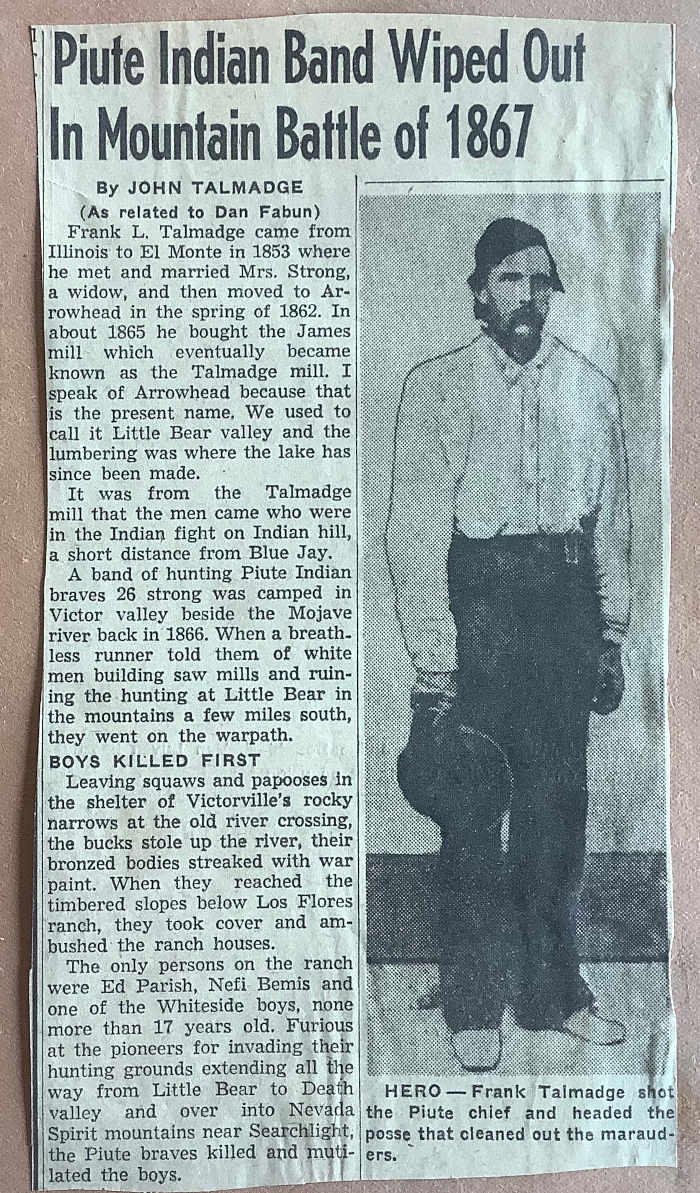
(caption) HERO - Frank Talmadge shot the Piute chief and headed the posse that cleaned out the marauders.
Their revenge completed for the time, the Indians returned to Victorville and their hunting pur-suits along the Mojave, where their families came out of hiding.
In 1867 reports had trickled down to the Pintos on the warm desert flats during the winter that their raid had not discouraged the whites in their building of saw mills and erecting log houses. So one morning in the spring the same band of painted braves moved their squaws and papooses to the spring behind Chimney Rock, a natural monument at the north end of Lucerne's Dry Lake west and north of Rabbit Springs.
BURN SAWMILL
Their families hidden and safe, the braves once again went on the warpath against the white pioneers in the mountains. At Little Bear they struck with all their pent up fury, burning the sawmill at Blue Jay,then razing the cabin of Bill Kane.
Opposition was met for the first time in the persons of Frank L. Talmadge; George Armstrong, Frank Blair, one of the Birdwell clan; Jonathan Richardson, uncle of the late governor, Friend Richardson; John Welty. In the battle that followed, several Indian braves were killed and wounded, their companions dragging them along and hiding them in the tall mesquite.' Bill Kane, another member of the surprised white men, was wounded in the leg by an arrow, John Welty was shot through the shoulder.
The late Will Talmadge, who was a partner of Sheriff James W. Stocker in the cattle business until his death several months ago, often told his recollections of the fight. Will could remember, how his father washed the wound of the mill boys with hot soap and water and cleaned it out with a silk scarf to remove bits of shirt stuck inside. He knew six or more Indians were killed and that the surviving braves carried off the bodies.
TALMADGE GETS CHIEF
Talmadge killed the Indian chief with an over and under double barrel rifle, similar to one displayed in the Amerlean National bank window prior to this year's Covered Wagon Days. The chief was used to the muzzle loaders and Talmadge had fired once. The chief felt he was safe and left his tree to seek other cover from which to let loose more arrows. Talmadge had the second barrel ready and got the chief.
But the John Welty family and Frank Tahriadge had not finished with the Indian terrorists. They swung up into their saddles and rushed to San Bernardino to or-ganize a posse. The entire settlement was thrown into a panic when they heard of the mountain battle. Soon 40 men had joined the posse of Indian fighters. Some of the pioneer names were: Bill Holcomb, Leo Miller, George Lish, the Bemis boys, Weltys and Talmadges.
Expert trackers and all of them used to hunting grizzlies and deer, the posse took up the track of the Piutes and followed the moccasin tracks and bloody marks of the wounded. Deeper imprints indicated that the dead were still being carried, rather than being buried, Bill Kane's horse, shot from under him during the fight, was discovered, saddle untouched. The Indians were not robbers, or looters - they had attacked to wipe out the white invaders, whose whirring sawmills and logging operations were ruining a rich hunting ground of their ancestors. But the Indians had gone too far. Justice must be swift and final, by, the iron code of the frontier west, Indian raiders must be discouraged forever.
INDIANS WIPED OUT
The bloody trail twisted and, turned its way 35 miles through pine forests to Big Bear and the area now filled by an artifical lake. Gaining steadily, the mounted posse tracked the redskins down the roadless boulder strewn slopes, emerging on the desert on the south edge of Dry Lake. This hard-baked adobe mud lake stretched before them for five miles, the bloody tracks leading straight across to Chimney Rock. Smoke from Indian lodges at the hidden spring had been smothered. The Indians were hidden in the rock, grimly determined to fight for their lives and families, their backs to the wall.
Mr. Talmadge could not be sure how many of the Indians were killed in the ensuing massacre, but he remembers dozens of bows, arrow quivers, beaded moccasins and trappings of the many Indian families that were wiped out. With this battle, Indian raids were forever stopped. The mountains were far different in the early days from what they are today. Grizzly were found on both north and south slopes. Isaac Slover for whom Slover mountain was named was killed by a grizzly in the Swarthout canyon district. Sam Bemis was killed by a grizzly in what is known as Miller canyon now but was formerly referred to as Dark canyon. All bear were cleaned out of the San Bernardino mountains soon after the railroads were built, but brown bear were introduced again in the early 1930s being imported from northern California when J. Dale Gentry was chairman of the fish and game commission under Gov. James Rolph.